Values Charter – Toitvert.ch
A local company for your green roofs!
Against a backdrop of urban infrastructure saturation and climate change, the greening of buildings and urban spaces is a strategic tool for urban planning.
That is why TOIT VERT SA ensures that its work complies with the SIA standards on green roofs and the PACOM guidelines, by developing green roof solutions that have already been recognised and awarded for their ecological, circular, sustainable, local and innovative nature.
The development of TOIT VERT SA’s activities incorporates the principles of the Green and Blue Infrastructure framework advocated by the cantons in their spatial planning schemes, in particular:
- Stormwater management and flood control
- The logic behind the ‘Sponge City’ concept
- The ecological resilience of the existing urban fabric
The Charter of Values sets out the principles, commitments and technical criteria that guide the design, production and implementation of the green roof solutions developed by TOIT VERT SA.
Fundamental principle: greening as infrastructure
Greening is not regarded as a decorative feature, but as a functional ecological infrastructure that helps to:
- Increasing biodiversity by providing a habitat for insects and microfauna
- Reducing urban heat islands
- Decentralised stormwater management, filtration and treatment
- Reducing energy consumption in buildings, both in summer and winter
- Extending the lifespan of buildings
- Reducing sound transmission
- Improving indoor air quality
- CO₂ capture 365 days a year
- Not to mention the significant improvement in well-being and quality of life in the city!
Scope of the Value Charter
This code of values applies to all greening projects, both public and private, including:
- Extensive, semi-intensive or intensive green roofs, flat or sloping
- Measures to promote the retention, infiltration and gradual release of rainwater
- Integrated urban greening projects designed to address climate and water management issues
Horticultural production principles applied in the nursery
TOIT VERT SA’s commitment:
- Integrating local sourcing of raw materials
- Farming without the use of chemical inputs or pesticides
- Tailoring solutions to local climatic conditions
- Ensure that production meets the PACOM and SIA targets
- To contribute to the local and circular economy by minimising our carbon footprint
The principle of integrated stormwater management and the «Sponge City» approach»
TOIT VERT SA’s commitment:
- Prioritise retention, infiltration and evapotranspiration at source
- Slowing down the flow
- Temporarily storing water in the substrates
- Encourage slow infiltration where conditions allow
- Gradually return the water to the plant and the atmosphere
The «Sponge City» principle»
Each project is designed to form part of the urban water system, complementing the existing networks.
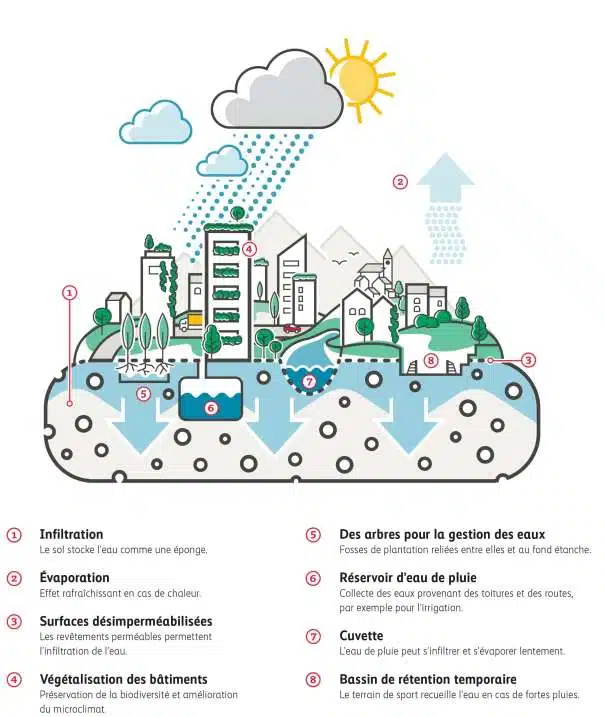
- Infiltration : the soil stores water like a sponge.
- Evaporation : a cooling effect in hot weather.
- Unsealed surfaces : Permeable surfacing allows water to seep through.
- Greening of buildings : preserving biodiversity and improving the microclimate.
- Trees for water management : planting pits connected to one another and with a watertight base.
- Rainwater tank : collecting water from roofs and roads, for example for irrigation.
- Toilet bowl : Rainwater can seep in and evaporate slowly.
- Temporary retention basin : The sports ground collects water during heavy rainfall.
The principle of the circular economy, which helps to minimise the carbon footprint
The greening solutions developed are designed to be locally sourced, sustainable and based on short supply chains, using recycled raw materials and a plant production process that aims to be self-sufficient in terms of seeds and seedlings. In order to minimise the production carbon footprint as much as possible, raw materials are currently sourced from within a 100 km radius.
TOIT VERT SA’s commitment:
- Use of locally sourced, reclaimed materials (recycled minerals, regional composts)
- On-site production of substrates
- Restrictions on the use of materials
- Long-term stability and minimal degradation
The principle of sustainability and climate resilience
Green roofing solutions must function sustainably with a minimum of external inputs.
TOIT VERT SA’s commitment:
- A selection of native plants or ecotypes suited to urban conditions
- Reducing dependence on irrigation
- Design of systems resilient to droughts and heavy rainfall
- Striking a balance between water performance and structural constraints
Functional urban biodiversity
Biodiversity is an indicator of a healthy ecosystem.
TOIT VERT SA’s commitment:
- Creating biodiverse habitats
- Promoting microfauna habitats that are compatible with built-up areas
- Ecological connectivity at city level
Technical requirements and regulatory compliance
Sustainability is based on technical rigour.
TOIT VERT SA’s commitment:
- Design in accordance with the relevant SIA standards
- Compliance with PACOM requirements regarding greening
- Clear and practical technical documentation
- Anticipating regulatory changes
Economic sustainability and maintenance
A sustainable project must be economically viable in the long term.
TOIT VERT SA’s commitment:
- Low-maintenance solutions
- Anticipating maintenance requirements right from the design stage
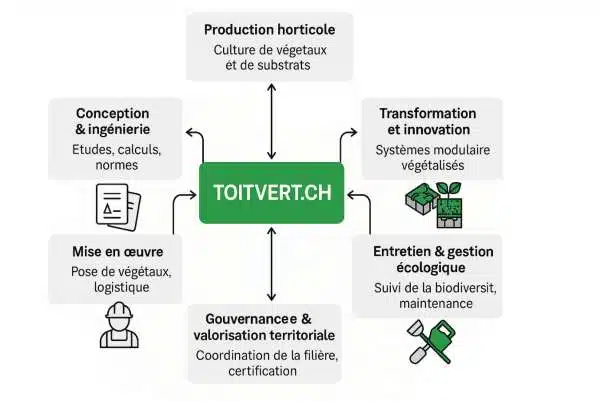
- Contribution to the development of a local greening sector
- A focus on total cost, rather than initial cost alone
Demonstration projects and replicability
Urban transition relies on replicable solutions.
TOIT VERT SA’s commitment:
- Development of demonstration projects with local authorities
- Capitalising on lessons learnt
- Prudent standardisation of solutions
- Transferability at local and inter-local authority level
Long-term vision
Through this Charter of Values, TOIT VERT SA sets out its long-term vision for the development of an urban greening sector, bringing together all the expertise required to implement sustainable urban greening. The vision for the sector created by TOIT VERT SA thus enables:
- Making urban greening a circular economic model centred on climate resilience
- Fully integrating water management into urban planning
- Supporting local authorities’ urban greening initiatives